


William Aird: Understanding the Ferritin Surge After IV Iron
William Aird, Professor of Medicine at Harvard Medical School, posted on X:
”IV Iron and Ferritin
I recently posted a question about the spike in serum ferritin after IV iron. It can shoot from <10 to >1000, yet transferrin saturation (TSAT) only rises to normal — it barely moves.
What’s going on? This is macrophage physiology in action.
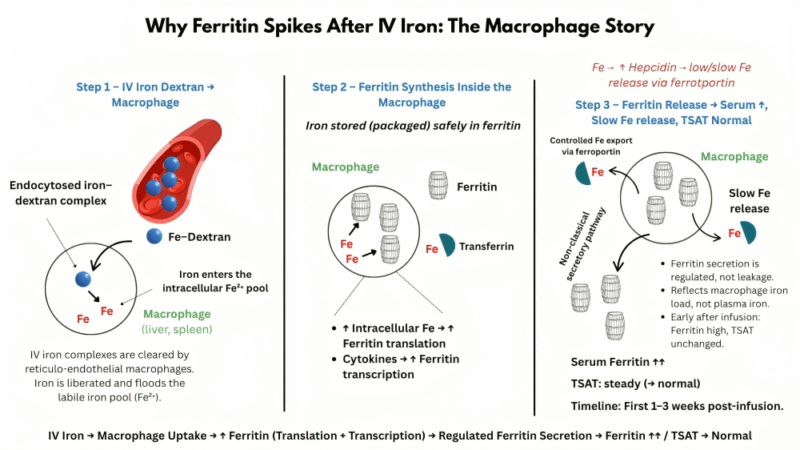
Step 1 – Uptake
IV iron–carbohydrate complexes (e.g., iron dextran) are endocytosed by macrophages in the liver, spleen, and marrow. Inside, the iron is released and floods the labile Fe²⁺ pool, the cell’s internal “iron bank.”
Step 2 – Ferritin synthesis explodes
- High intracellular Fe²⁺ flips the IRP–IRE switch, unleashing translational ferritin synthesis.
- Cytokines add a transcriptional boost.
- Ferritin production ↑↑ → serum ferritin rises via a regulated, non-classical secretion pathway.
Step 3 – The lab pattern
During the first 1–3 weeks after infusion:
- Ferritin ↑↑ (macrophage storage + secretion)
- TSAT ↑ to normal (as a small fraction of iron slowly transfers to transferrin)
Step 3 (cont’d)
Fe release is slow, because hepcidin levels rise after IV iron, throttling ferroportin and keeping iron temporarily trapped in macrophages (only a slow trickle of iron is exported via ferroportin into the bloodstream). This is redistribution, not overload.
Step 4 – Resolution
- As macrophages slowly export iron via ferroportin, their intracellular iron falls. The IRP–IRE system re-engages, ferritin synthesis drops, cytokine signals fade.
- Serum ferritin settles to a new, steady level.
Bottom line:
Ferritin spikes after IV iron because:
- Macrophages are suddenly iron-loaded → ↑ ferritin translation
- Cytokines transiently ↑ transcription
- Ferritin is secreted into plasma
As iron normalizes, ferritin synthesis and secretion taper.
Clinical takeaway: If you see ferritin >1000 and TSAT merely normal after IV iron, think macrophage response, not iron overload. Ferritin is telling you iron has arrived; it just hasn’t moved on yet.”
Stay updated with Hemostasis Today.
-
Oct 9, 2026, 13:55Chandler Purser: AABB 2026 Focuses on Transfusion Safety and Audit-Driven Practice Improvement
-
Oct 9, 2026, 13:48Maxime Dely: Raising Awareness for Blood Donation
-
Oct 9, 2026, 13:48Vera Ghali: Anemia in Myelofibrosis and Its Impact on Treatment Outcomes and Overall Survival
-
Oct 9, 2026, 13:32W David Freeman։ The Mechanical Penumbra in Intracerebral Hemorrhage and Its Potential for Tissue Recovery
-
Oct 9, 2026, 13:11Ayshathul Noora։ Carbetocin vs Oxytocin in Preventing Postpartum Hemorrhage
-
Oct 9, 2026, 13:07The Rebalanced Patient: New Therapies and New Thrombotic Risks in Hemophilia
-
Oct 9, 2026, 12:48Santiago Cepeda Chafla: CereBleed Simplifies Brain Hemorrhage Assessment
-
Oct 9, 2026, 12:34Abdul Muqtadir Abbasi: Pancytopenia Is a Finding, Not a Diagnosis
-
Oct 9, 2026, 12:24Mercy Lung’aho: When Diet Quality and Nutritional Biomarkers Tell Different Stories