


Heghine Khachatryan: How Blood Tests Help Manage Antiphospholipid Syndrome in Pregnancy
Heghine Khachatryan, Editor-in-Chief of Hemostasis Today, Head of Hemophilia and Thrombosis Center at Yeolyan Hematology and Oncology Center, shared RPTH Journal’s post on LinkedIn:
”Antiphospholipid Syndrome in Pregnancy — A Hematologic Determinant of Outcomes
Antiphospholipid syndrome (APS) remains one of the most complex and underrecognized conditions in obstetric medicine, with direct implications for both maternal and fetal outcomes.
Why it matters:
- Strongly associated with recurrent pregnancy loss (RPL), placental insufficiency, and thrombotic events
- Frequently underdiagnosed or misclassified
- Represents a spectrum of risk rather than a single entity
High-risk profiles include:
- Triple-positive antiphospholipid antibodies
- History of unprovoked or recurrent thrombosis
- Refractory obstetric APS
Core management principles:
- Combination therapy: low-dose aspirin plus LMWH (risk-adjusted dosing)
- Continuous monitoring throughout pregnancy
- Multidisciplinary care (hematology–obstetrics collaboration)
- Adjunctive therapies in selected cases (e.g., hydroxychloroquine)
Key message:
APS in pregnancy is not merely a diagnosis—it is a risk stratification framework requiring precision medicine.
Early recognition and tailored intervention can significantly improve pregnancy outcomes.”
RPTH Journal shared a post on LinkedIn:
”Antiphospholipid syndrome in pregnancy: one of hematology’s most complex challenges.
Antiphospholipid syndrome (APS) is a multisystem autoimmune disorder that significantly raises the risk of blood clots and adverse pregnancy outcomes. Diagnosing it is often difficult, treatment options remain limited — and pregnancy adds a whole new layer of complexity.
A state-of-the-art review in RPTH Journal based on a lecture presented at the International Society on Thrombosis and Haemostasis (ISTH) 2025 Congress, offers a hematologic perspective on APS management during pregnancy, including prepregnancy counseling and thrombosis-related issues.
Key takeaways:
- APS carries high risks of thrombosis and late adverse pregnancy outcomes
- Management relies on anticoagulation and close specialist monitoring
- Risk stratification remains a major unmet need
- Few novel treatments are on the horizon…
This review focuses primarily on late pregnancy complications and thrombotic issues rather than earlier events such as recurrent miscarriage, which fall more within the obstetric perspective.
More than 40 years after the initial description of APS by Graham Hughes, there is still much to improve, especially in personalizing treatment to enhance outcomes for pregnant patients.”
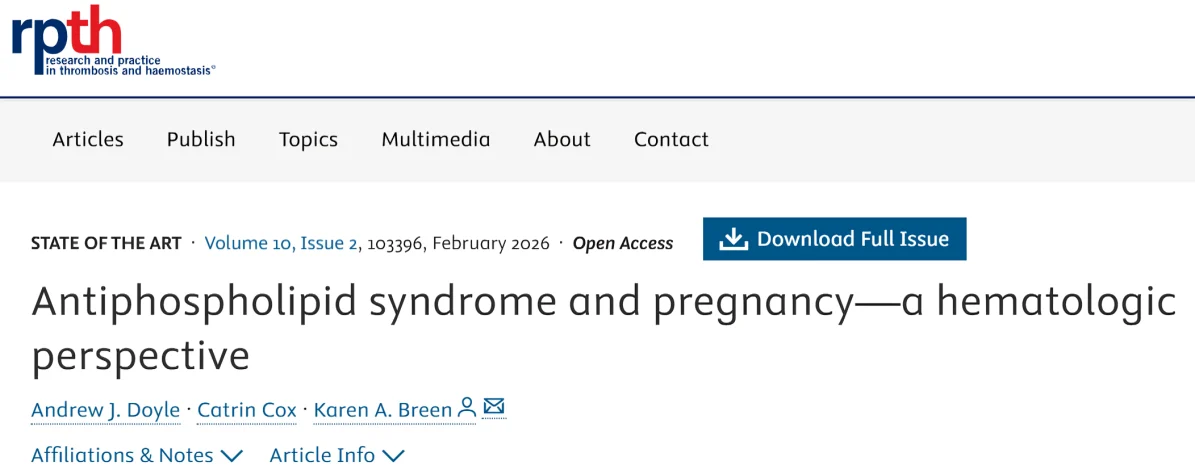
Title: Antiphospholipid syndrome and pregnancy—a hematologic perspective
Authors: Andrew J. Doyle, Catrin Cox, Karen A. Breen
Read the Full Article on Research and Practice in Thrombosis and Haemostasis
Other posts featuring Heghine Khachatryan on Hemostasis Today.
-
Oct 6, 2026, 16:43Beth Shirley: Xylitol Consumption Increases Platelet Reactivity and Cardiovascular Risk
-
Oct 6, 2026, 16:37Jared Rice: What Sets the Transfusion Threshold in Anemia of Prematurity?
-
Oct 6, 2026, 16:30Thirunavukkarasu Angappan: Immunoglobulin Decides How Much Plasma Gets Collected
-
Oct 6, 2026, 16:18Gemma Davies: New CMML Research Selected for Presentation at the 68th ASH Annual Meeting
-
Oct 6, 2026, 16:03Professor Csongor Kiss Receives the Kálmán Laki Prize – Hungarian Society of Thrombosis and Haemostasis
-
Oct 6, 2026, 15:52Mark Kheifets: A Massive Stent Thrombosis Requiring Aspiration Thrombectomy
-
Oct 6, 2026, 15:40Joseph Aslan։ Targeting Mitochondrial Permeability Transition To Reduce Platelet Thrombogenicity
-
Oct 6, 2026, 15:36Nominations Open for ISTH Outstanding Mentor Awards – ISTH
-
Oct 6, 2026, 15:17Walaa Obaid: How Warfarin Went From Poison To Medicine