

Francisco Chacón-Lozsán: Coma Is Not a Diagnosis – Final Pathway Of Brain Arousal And Awareness Failure
Francisco Chacón-Lozsán, Fellow at World Extreme Medicine, Member of European Society of Intensive Care Medicine (ESICM) and American College of Cardiology, shared a post on LinkedIn about recent article by Stein Silva et al., published in Intensive Care Medicine, adding:
“Coma is not a diagnosis…
It is the final common pathway of multiple catastrophic failures across the brain’s arousal and awareness networks.
And in the ICU, minutes matter.
This 2026 narrative review in Intensive Care Medicine proposes something many clinicians desperately need:
A truly structured, physiology driven, stepwise diagnostic strategy for coma of unknown origin.What makes this paper particularly valuable is that it moves beyond the classic ‘CT with labs and LP’ reflex approach.
Instead, it reframes coma through modern network neuroscience.
The authors emphasize that nearly all causes of coma ultimately converge on disruption of:
- the ascending reticular activating system (ARAS)
- thalamocortical connectivity
- frontoparietal networks responsible for awareness and arousal
This matters clinically.
Because bedside examination can still localize dysfunction surprisingly well.
The review highlights how:
- pupils
- gaze deviation
- respiratory pattern
- posture
- brainstem reflexes
can rapidly differentiate:
- metabolic/toxic coma
- diencephalic dysfunction
- pontine lesions
- medullary injury
- hemispheric structural lesions
One of the strongest messages of the paper:
Repeated reassessment is mandatory.
Not optional.
The authors recommend reassessment every 15–30 minutes initially, then every 2–4 hours once stable.
Coma is dynamic. A single neurological exam is never enough.
Another excellent point: normal CT does not exclude severe pathology.
MRI remains substantially superior for:
- posterior fossa lesions
- PRES
- diffuse axonal injury
- encephalitis
- venous thrombosis
- subtle ischemia
The EEG section is especially important for intensivists.
The paper reinforces that:
- up to 18% of mixed ICU coma populations may have nonconvulsive seizures
- continuous EEG is often required
- thalamocortical disconnection can potentially be inferred from EEG spectral patterns
The proposed ABCD EEG framework is fascinating: progressive slowing and suppression may reflect increasing thalamocortical disconnection.
Potentially allowing bedside neurophysiological stratification of coma severity.
Perhaps the most important conceptual shift in this review:
Moving from phenotypes to endotypes.
Not merely asking: ‘What syndrome is this?’
But instead: ‘What network is failing?’ ‘What mechanism is suppressing consciousness?’ ‘What dysfunction is reversible?’
That transition may fundamentally change neurocritical care in the next decade.
Reference
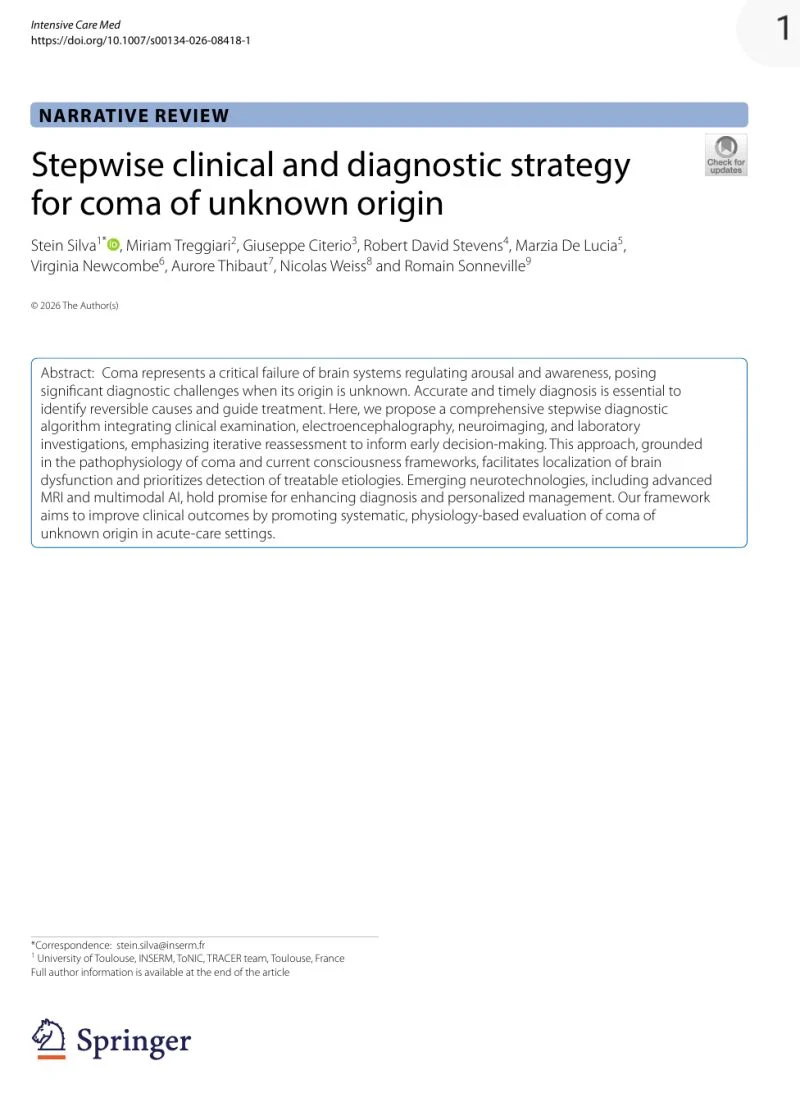
Silva S et al. Stepwise clinical and diagnostic strategy for coma of unknown origin. Intensive Care Medicine. 2026.”
Title: Stepwise clinical and diagnostic strategy for coma of unknown origin
Authors: Stein Silva, Miriam Treggiari, Giuseppe Citerio, Robert David Stevens, Marzia De Lucia, Virginia Newcombe, Aurore Thibaut, Nicolas Weiss, Romain Sonneville
Other posts featuring Francisco Chacón-Lozsán on Hemostasis Today.
-
Oct 20, 2026, 16:51Suzan Nakasendwa: A Growing Stroke Challenge in Uganda
-
Oct 20, 2026, 16:38Steve Moon: How Does Smoking Cessation Duration Affect Ischemic Stroke Risk
-
Oct 20, 2026, 16:25Cedrice Mentor: Reducing Platelet Wastage Through Cold Storage
-
Oct 20, 2026, 16:09Thirunavukkarasu Angappan: Can a Purified Fibrinogen Concentrate Replace Cryoprecipitate
-
Oct 20, 2026, 16:01Kalyan Roy: Platelet Conservation Through Evidence-Based Transfusion Practice
-
Oct 20, 2026, 15:28Stacy E. Croteau: 33 Countries, One Mission – Better Bleeding Disorder Care
-
Oct 20, 2026, 15:19Teresa Barnes: What Does a Pulmonary Embolism Mean for Jalen Hurts?
-
Oct 20, 2026, 15:04Laura S.: Could Speaking Up Prevent Maternal Deaths from Thrombosis?
-
Oct 20, 2026, 14:44Pete Stibbs: VTE in Professional Athletes – When Fitness Is Not Enough