


Danny Hsu: A Practice-Changing Milestone in Managing Post-Thrombotic Syndrome
Danny Hsu, President of THANZ, Director of Therapeutic Apheresis, Immune and Obstetric Haematology at South Western Sydney Local Health District, shared on LinkedIn about a recent article by Suresh Vedantham et al, published in NEJM, adding:
”A Practice-Changing Milestone in Managing Post-Thrombotic Syndrome!
I am incredibly excited to highlight a landmark paper just published in the NEJM: the C-TRACT trial.
Post-thrombotic syndrome (PTS) frequently develops after acute proximal deep-vein thrombosis and can cause severe chronic limb pain, swelling, and ulcers that drastically impair a patient’s quality of life.
For years, the precise clinical benefits and risks of utilizing endovascular interventions for this debilitating condition have remained unclear.
The Phase 3 C-TRACT trial brings much-needed clarity.
It randomized 225 patients with moderate or severe PTS and imaging-confirmed iliac-vein obstruction to receive either standard care alone or standard care combined with endovascular therapy (iliac-vein stenting and enhanced antithrombotic therapy).
Here are the key practice-changing takeaways from the 6-month data:
Significant Symptom Relief:
The severity of PTS was significantly lower in the endovascular-therapy group, demonstrated by a mean Venous Clinical Severity Score (VCSS) of 8.1 compared to 10.0 in the standard care group.
Many patients shifted to lower severity categories, indicating reduced life interference from their venous disease.
Major Quality of Life (QoL) Improvements:
Patients receiving endovascular therapy reported a massive 14.5-point adjusted improvement in venous disease-specific quality of life on the VEINES-QOL questionnaire. Overall physical quality of life was also significantly better.
The Clinical Trade-off:
These benefits must be weighed against safety outcomes; bleeding was significantly more common in the endovascular-therapy group (11.6%) than in the standard care group (3.6%).
Why this changes our practice:
This robust trial firmly supports the ‘open-vein hypothesis,’ proving the substantial clinical value of restoring iliac-vein outflow after a DVT.
It provides us with the high-quality evidence needed to confidently offer endovascular stenting as a powerful tool to reduce the severity of PTS.
However, it also clearly outlines the clinical trade-off: the enhanced antithrombotic therapy required to maintain stent patency increases bleeding risk.
We now have the data to facilitate truly informed, shared decision-making with our patients regarding the risks and profound functional benefits of iliac-vein stenting.”
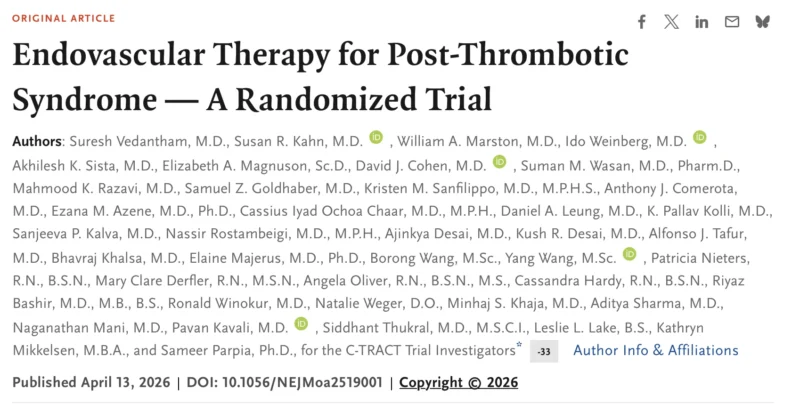
Title: Endovascular Therapy for Post-Thrombotic Syndrome — A Randomized Trial
Authors: Suresh Vedantham, Susan R. Kahn, William A. Marston, Ido Weinberg, Akhilesh K. Sista, Elizabeth A. Magnuson, David J. Cohen, Suman M. Wasan, Mahmood K. Razavi, Samuel Z. Goldhaber, Kristen M. Sanfilippo, Anthony J. Comerota, Ezana M. Azene, Cassius Iyad Ochoa Chaar, Daniel A. Leung, K. Pallav Kolli, Sanjeeva P. Kalva, Nassir Rostambeigi, Ajinkya Desai, Kush R. Desai, Alfonso J. Tafur, Bhavraj Khalsa, Elaine Majerus, Borong Wang, Yang Wang, Patricia Nieters, Mary Clare Derfler, Angela Oliver, Cassandra Hardy, Riyaz Bashir, Ronald Winokur, Natalie Weger, Minhaj S. Khaja, Aditya Sharma, Naganathan Mani, Pavan Kavali, Siddhant Thukral, Leslie L. Lake, Kathryn Mikkelsen, Sameer Parpia
Stay updated on all scientific advances with Hemostasis Today.
-
Oct 21, 2026, 00:58Anees Ur Rahman: Completing a Two-Week Clinical Rotation at Haemophilia Treatment Centre Rawalpindi
-
Oct 21, 2026, 00:56Caitlyn Mooney: Pulmonary Embolism in Athletes, Recognition and Return to Sport
-
Oct 21, 2026, 00:54Hani Karrar: Pleased to Share Our Review on Emicizumab in Hemophilia A Management
-
Oct 21, 2026, 00:53Akshay Sharma: HSCT Leads to Sustained Improvements in Sickle Cell Cardiomyopathy for Up to 3 Years
-
Oct 21, 2026, 00:51Prateek Meena: The F. A. T. R. N. Mnemonic for Recognizing TTP
-
Oct 20, 2026, 23:51Registration Is Open for WFH CCS 2027 – World Federation of Hemophilia
-
Oct 20, 2026, 23:44Edward Lee Carter: AF in Nursing Homes – When Stroke Risk Scores Tell Only Part of the Story
-
Oct 20, 2026, 22:59Building Effective Patient Advocacy Through Collaboration Between Patients and Clinicians – EHC
-
Oct 20, 2026, 21:22Intezar Mehdi: When Prolonged Bleeding May Indicate an Underlying Bleeding Disorder